

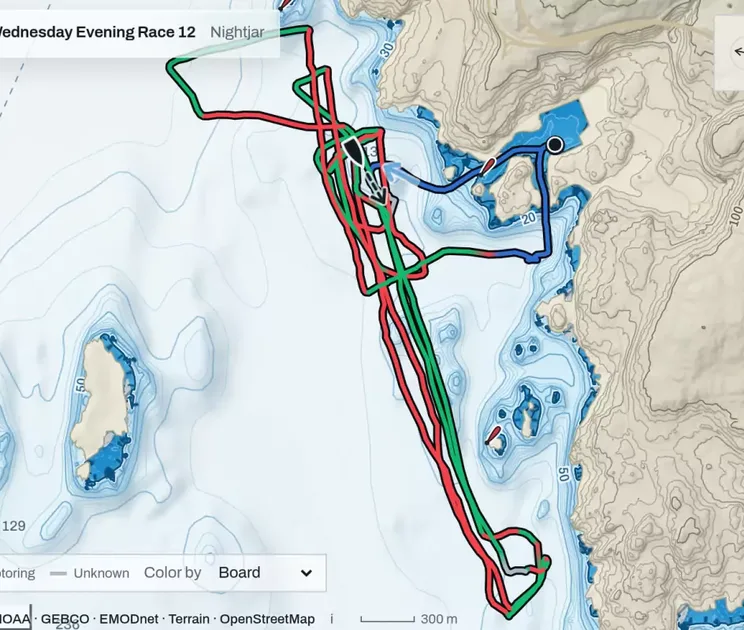

"We were slow downwind" is where most debriefs start and stop. Slow against what? In 6 kn of breeze every boat is slow. A polar answers that: it is the speed your boat should make at each true wind speed and angle, so a light patch is not mistaken for poor trim, and a fast reach in a gust is not mistaken for good sailing.
Telltale compares every moment of a recorded sail with that target, sums it up in one sentence, and numbers the stretches where the most time went. Here is how to read it, with Off Piste's evening race on 2 September 2026.
1. The answer first
Open a session and go to Performance. The first line says where the boat sailed closest to its polar and where it lost the most.
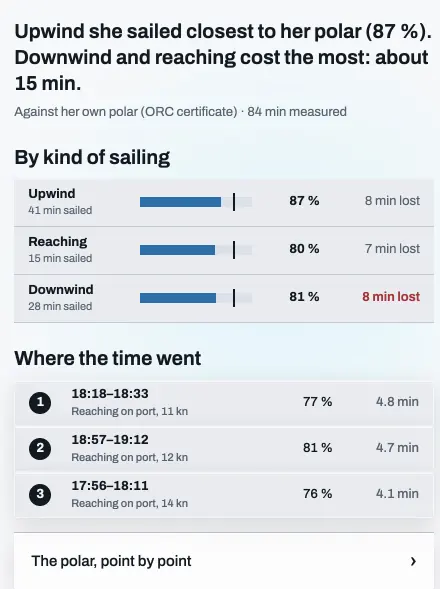
For Off Piste that evening: upwind at 87 % of polar, reaching at 80 %, downwind at 81 %. Reaching and downwind together cost about 15 minutes. That turns "we were slow downwind" into a number the crew can work on, and a number to beat next time.
2. Where the time went
Under the summary, Where the time went lists the stretches that cost the most, each with its time, the point of sail, the wind and the minutes lost. For Off Piste all three were reaches on port: 18:18 to 18:33 in 11 kn at 77 % of polar, 4.8 minutes; 18:57 to 19:12 at 81 %, 4.7 minutes; and 17:56 to 18:11 at 76 %, 4.1 minutes.
Three reaches on the same tack is a pattern, not bad luck. That is the debrief: what was the reaching set-up on port, and who was trimming?
3. What happened there
Move the cursor to one of those times and the lanes under the chart follow it: boat speed, wind angle and true wind, all on one clock, with the board bar showing the tack. Colour by switches the track on the chart from tack to percent of polar, and + Lane adds percent of polar and its target as lanes of their own.
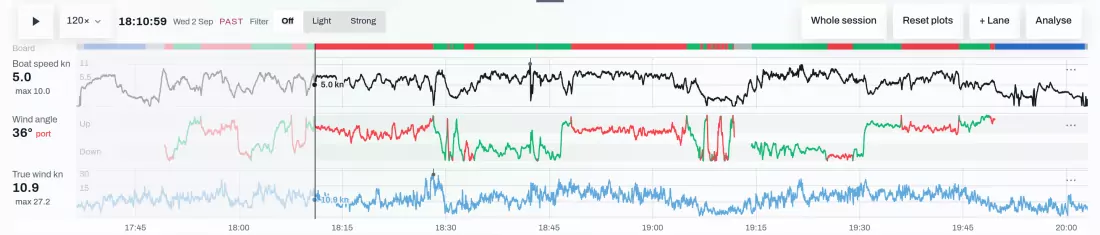
Read the wind angle through the stretch. Sailing too deep or too high for the breeze shows up as a steady angle away from the target with speed down. A drop that comes and goes with the wind is a pressure or a trim question. Then ask the crew what they saw at that minute: the lanes say where, the people aboard say why.
4. Check the wind you were in
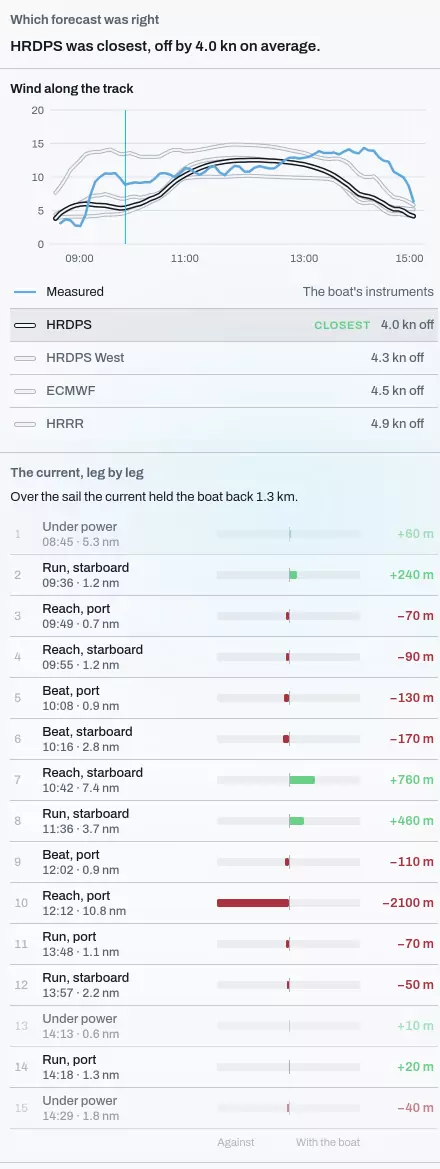
A slow stretch in a forecast that never arrived is a different lesson from a slow stretch in steady wind. The Forecast tab sets each model's wind along your track against what you measured, and says which came closest.
Getting numbers you can trust
- Calibrate the log. A log that reads 5 % low makes every stretch look 5 % slow. Check boat speed against speed over ground in still water.
- Use a polar that fits the boat. Look up the boat's ORC certificate, or use the designer's polar. Most boats sail below 100 % most of the time; the trend from race to race matters more than the number.
- Record before you leave the dock. If an instrument drops out, its lane shows the gap rather than a guess.
With GPS alone there is no speed through the water, so there is no percent of polar. You still get the track, speed over ground, the tacks and gybes and, with AIS, the fleet. More on what Telltale works out and how is in the guide to AI sailing analysis and coaching and the recording and review guide.