

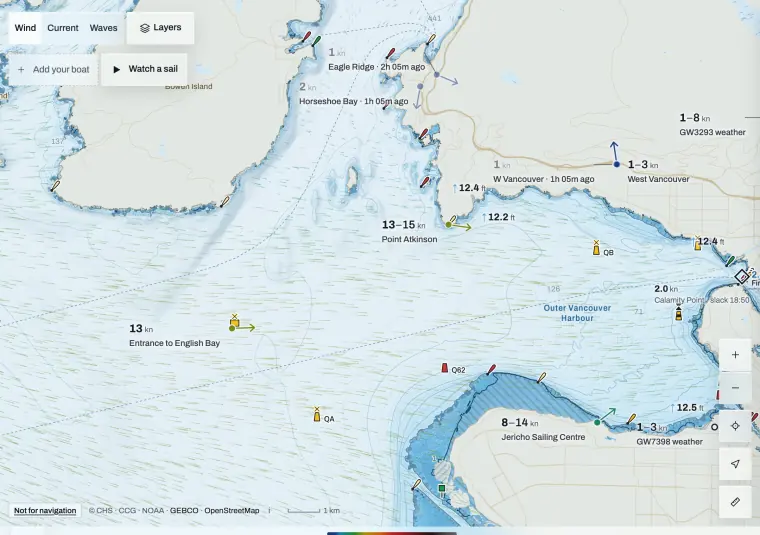
Sea breeze and thermal fill
On a clear day the land heats, the air over it rises, and sea air flows in underneath.
It usually starts late morning, peaks mid-afternoon and fades toward evening. A strong opposing gradient wind or thick cloud can stop it, and it often arrives earlier or later than the model has it.
Headlands
Wind squeezes and speeds up around a point.
Expect more wind and a lift or header just off the tip, and a light, shifty patch tucked in behind it.
Lees: rock and trees together
The shelter behind high land comes from the whole obstacle, terrain plus forest.
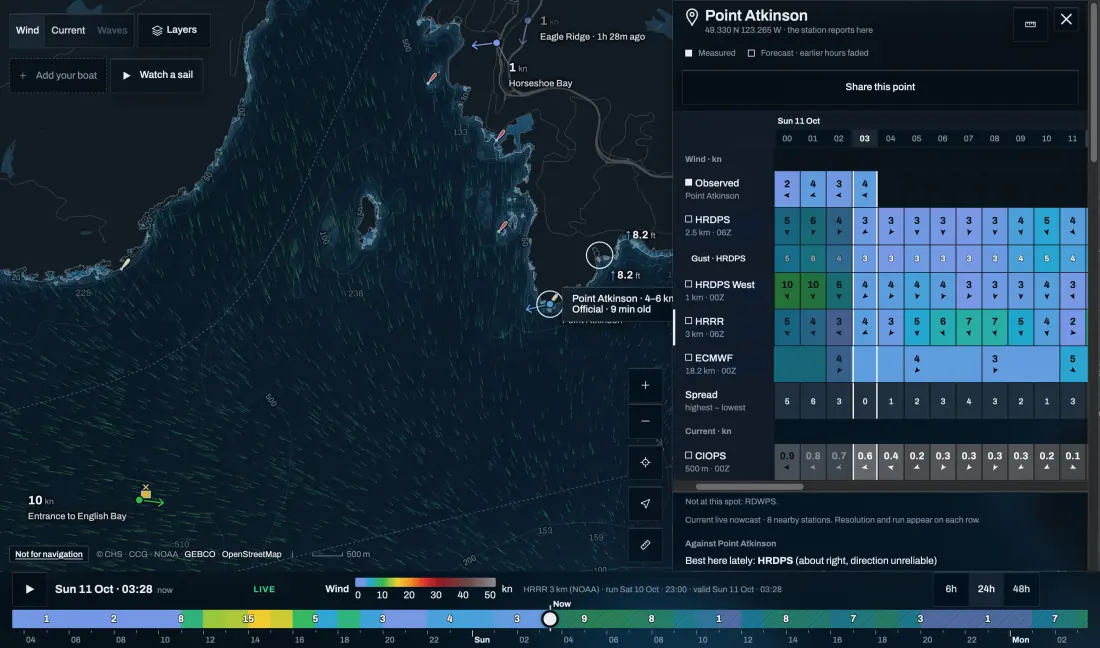
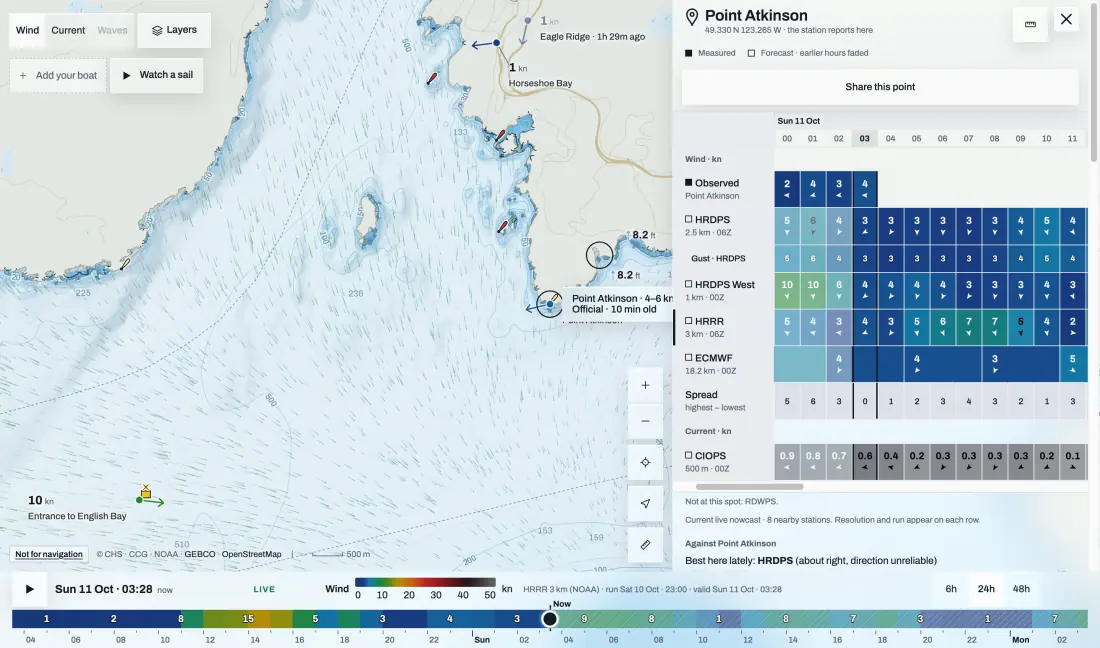
A rock headland with tall trees on it is taller, as far as the wind is concerned, than its rock alone. At Lighthouse Park, at Point Atkinson, the lee comes from both the elevated rock and the forest on top of it, and the light patch reaches further downwind than the rock alone would suggest. Cutting the corner through it is usually lighter and shiftier for longer than it looks.
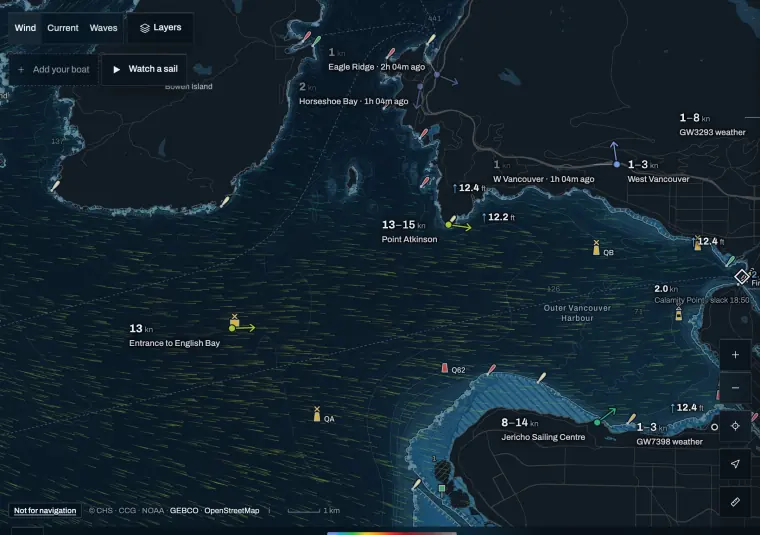
Channelling and outflow
Steep walls turn the wind to run along an inlet.
Howe Sound is the local example: inflow up the sound by day, outflow down it at night and in the morning, with the strongest wind where it narrows.
Convergence and divergence
Along a straight coast, the land can squeeze the wind into a band.
Friction over land slows the wind and backs it. Stand with the wind at your back: with the land on your right, the land air turns into the sea air and the wind is stronger in a band along the coast. With the land on your left, the two spread apart and the band is lighter. This holds in the northern hemisphere.
Shore bends and refraction
Wind crossing a shore turns to come more square off it.
Close in, expect a shift toward perpendicular to the shoreline. Along a bending shore that means the wind direction changes as you sail along it.
Gusts off high land
Under high shores, the wind arrives in bursts.
Air tumbling over steep land brings fast air from above down to the water. Watch for dark patches and be ready to ease.
Sources and review
Official references checked on 2026-10-11. Product details and schedules change; the provider’s page is the current word.