Physical AI for the water: cameras, instruments and forecasts in, measurements and decisions out, for every boat, race and venue.
Telltale is led by Arek Sredzki, a physical AI engineer who spent a decade on autonomous driving at Google and Tesla, where he trained the end-to-end neural networks behind Full Self-Driving. We are looking for partners who want to put this on the water.
Arek Sredzki spent the last decade at the forefront of autonomous driving and safety-critical robotics, at Google and then at Tesla. At Tesla he trained the end-to-end neural networks that power Full Self-Driving (FSD), led and shipped Actually Smart Summon, and helped develop and ship fully driverless robotaxis.
Before that he was software lead for UBC Sailbot, whose boat, Ada, set the record at the time for the longest autonomous sail across the Atlantic. Telltale is where both halves of that career meet: AI that has to be right in the physical world, pointed at the sport he has raced since he was a kid.
The method is the one that ships cars: real-world data at scale, models that learn from it, and proof against reality before anything goes out. Every project here is tested on real recorded races.
Pick a step. Each picture is a real output from our pipeline on real footage, from the first detection to the air flowing over the sail.
Step 1 of 5
Find and track every boat
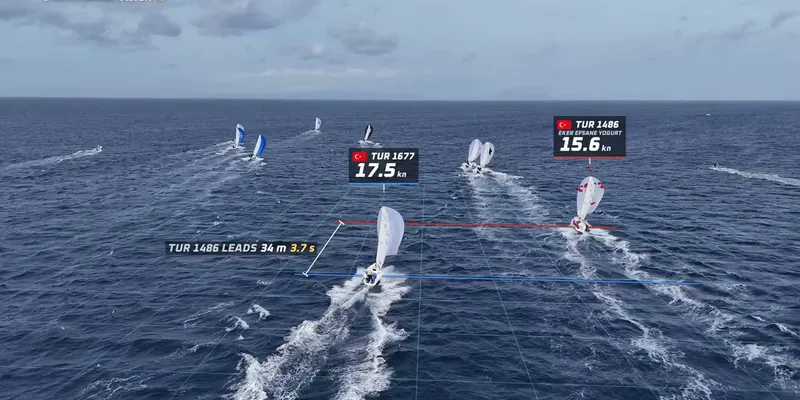
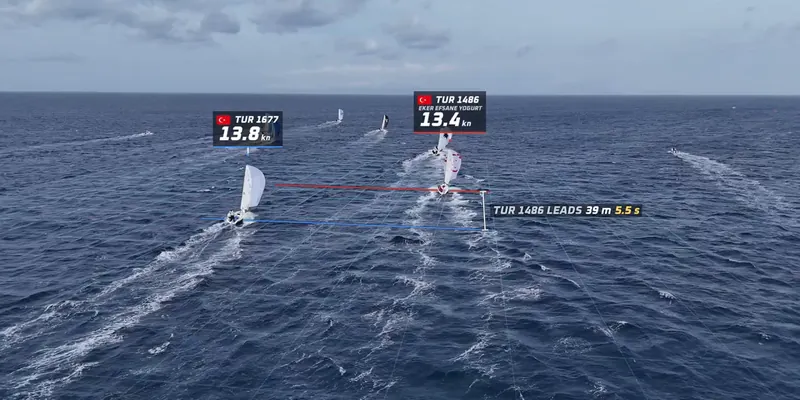
Every boat is found in each frame of a drone clip and followed through the fleet. From the track alone come each boat’s speed and the lead between boats in metres and seconds, with the camera’s own motion taken out. No transponder on the boats.
Step 2 of 5
Cut out the boat, then the people on it
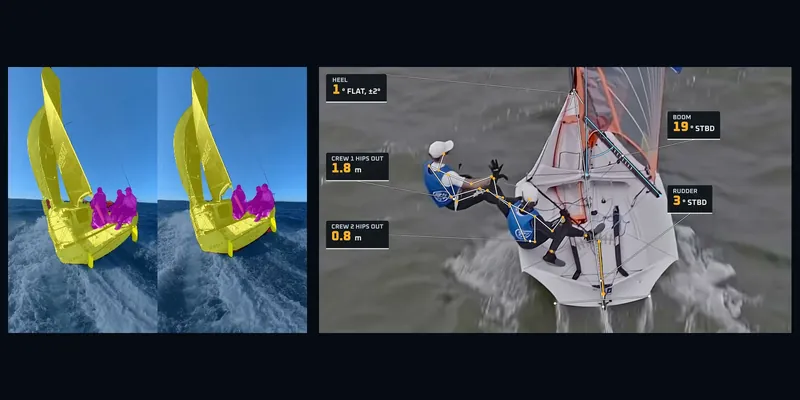
Pixel masks separate hull, sails and crew from the sea, and body pose finds both sailors and the helm. Left: sails (yellow) and crew (magenta) cut out of onboard footage. Right: hull axes, rudder, boom and both crew’s poses on a 29er from a drone.
Step 3 of 5
Solve where the camera is and how it points
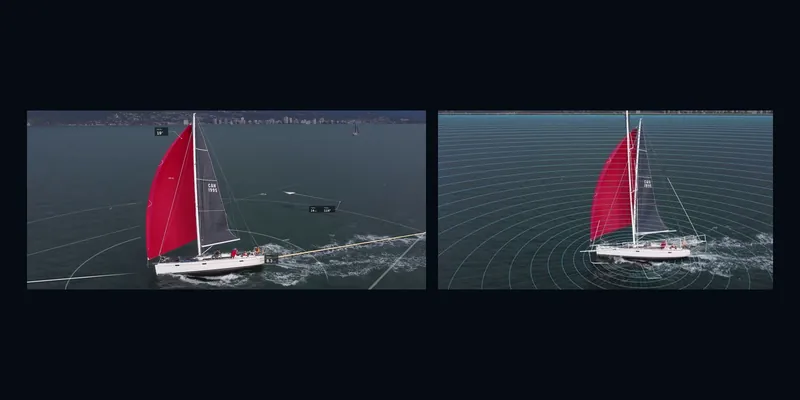
The horizon, the sea surface and known boat dimensions pin down the camera’s height, angle and lens. Once the camera is solved, graphics can live on the water instead of on the screen: left, heel, speed and true wind held to the sea as the drone moves; right, the sea grid the solve draws.
Step 4 of 5
Fit the 3D boat and sail to the photo
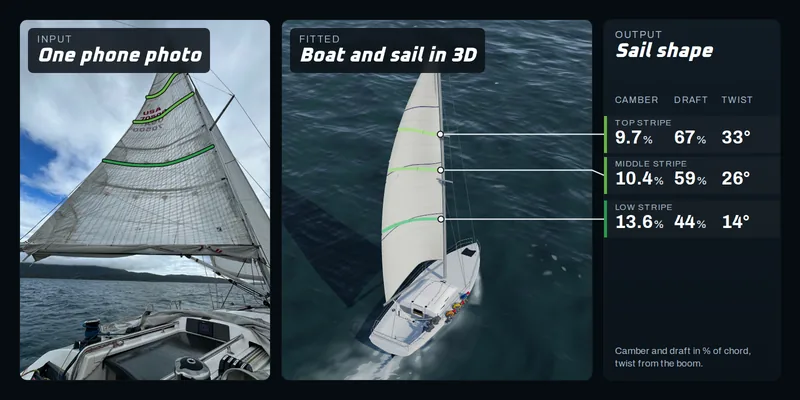
From one phone photo, the traced draft stripes of a mainsail become a 3D sail on a 3D boat, with camber, draft and twist at each stripe. Left: the real photo with its stripes traced. Middle: the fitted boat and sail in 3D. Right: what it measures.
Step 5 of 5
Then see the air
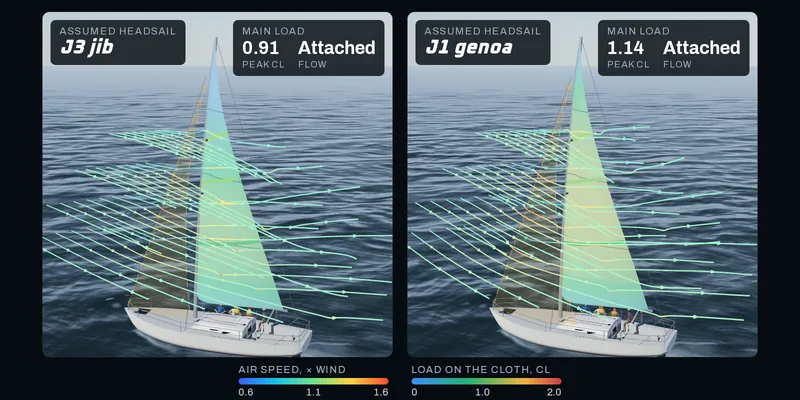
With the shape in 3D, Telltale draws the air over it: streamlines coloured by speed, and the load on the cloth. Change what the model assumes (here the headsail, a J3 jib on the left, a J1 genoa on the right) and the flow and the load change with it.
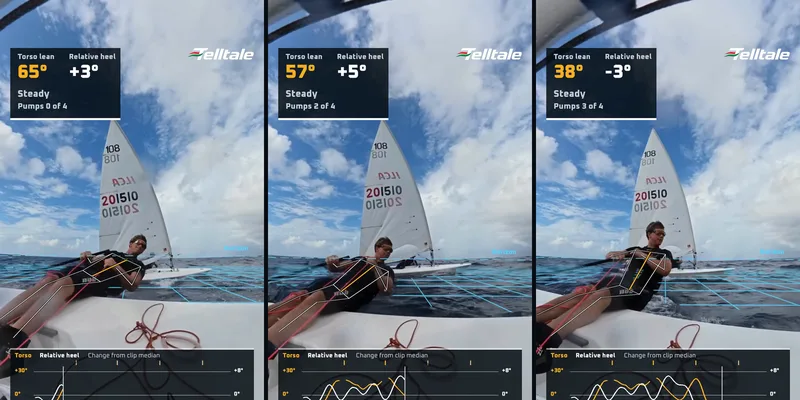
Body pose for the sailor in every frame, and from it torso lean, heel and each pump stroke on an ILCA, from ordinary onboard video.
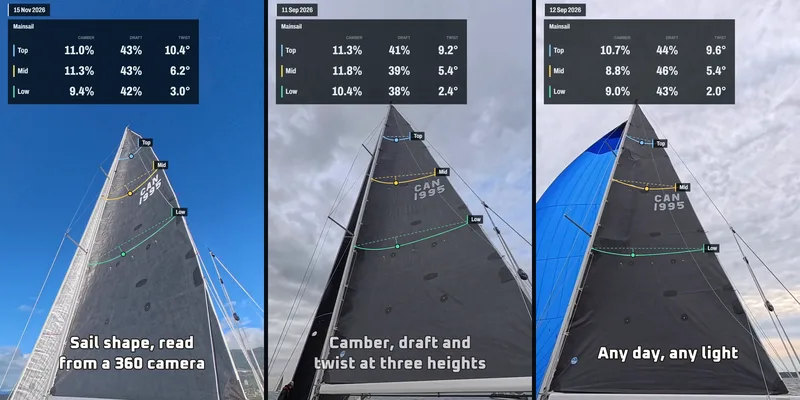
In the lab · 3 heights camber, draft and twist
Sail shape from a 360 camera
A 360 camera on deck reads the mainsail’s draft stripes and gives camber, draft and twist at three heights, on any day and in any light, while you race.